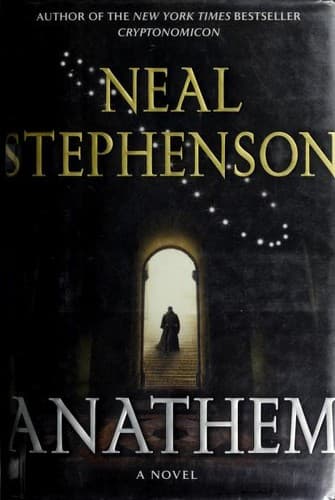
Our Review
I devoured Stephenson's Snow Crash, Diamond Age and Cryptonomicon. I was hungry for something similar - Anathem was anything but. On the planet Arbre, Stephenson constructs a world where intellectuals are cloistered in monastic communities called "maths," permitted to interact with the outside world only at intervals of one year, ten, a hundred, or even a thousand years, depending on the austerity of their vows. It is a book deeply concerned with the act of thinking and what it truly means to pursue knowledge for its own sake.
There was almost no element of science fiction, or even much advanced technology, from the start of the novel. I was, however, enthralled with the idea of intellectuals being cloistered away. The quiet halls of the "mathic" world draw you in slowly, replacing the techno-thriller adrenaline with something more contemplative — a narrative that asks what happens when thinkers are given centuries to simply think.
Of course, being a Stephenson novel, the quiet intellectualism eventually gives way to a grander scale. It turns out to be a science fiction novel after all, just not the kind you were expecting. If you like to find sci-fi in unexpected places, this book is for you. It is a stirring reminder that the most powerful thing we can do is simply stop, retreat, and think. At the end of the book I was surprised to find a page dedicated to an organization called the Long Now Foundation. Here was a movement of thinkers and makers explicitly turninig their backs on instant gratification through art and engineering.
The 10,000 Year Clock captured my imagination right away. I had no idea it was based on a real clock that was still a concept, not yet built. It aims to serve as a physical manifestation of "long-term" thinking, a radical departure from our modern obsession with the immediate. Years later, my company, Boca Bearings, actually supplied the ceramic bearings for the Long Now Foundation's physical 10,000 Year Clock — materials engineered to resist corrosion and wear for ten millennia. A book I read while sitting in a Florida office became, in the most literal sense possible, a part of something I helped build.
For readers who want to explore Stephenson's range further, Neuromancer by William Gibson makes an excellent companion—both authors helped define the cyberpunk genre, though they took it in radically different directions.