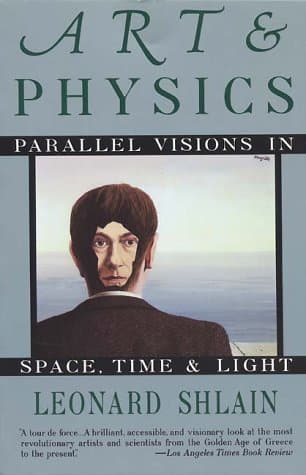
Art & Physics: Parallel Visions in Space Time & Light
Leonard ShlainPublished 1993 · ISBN 9780688123055
Our Review
I first encountered Leonard Shlain's "Art & Physics" on a friend's coffee table in Washington DC, shortly after I graduated from UMass Amherst. We were supposed to be catching up, but I became so utterly consumed by Shlain's ideas that my friend finally told me to just take the book home—on the condition that I actually engage in conversation for the rest of the night. On the train ride back I was grateful to have hours of uninterrupted time to dig deeper into the book.
Shlain argues that avant-garde artists have consistently anticipated the breakthroughs of physicists, intuiting new understandings of space, time, and light long before scientists formalized them. Shlain's gift is making these vast, sweeping connections feel accessible. He shows us how Perspective gave way to Cubism before Einstein dissolved absolute space, and how Impressionism dissolved stable matter before quantum mechanics turned uncertainty into a principle. It is a stirring reminder that the silos we build between "technical" and "creative" pursuits are modern inventions; the Greeks and the Humanists knew better.
The most arresting moments of the book occur when Shlain translates abstract physics into visual poetry. I still think about his analysis of Salvador Dalí's "The Persistence of Memory," which portrays the subjective distortion of time. Seeing Dalí's melting clocks as a visual representation of relativity—challenging the classical view of time as an absolute, unchanging flow—left a deep impression on me. While some might argue the connections are more suggestive than causal, that is where the book's charm lies. It isn't trying to be a laboratory manual; it is a mind-bending tour through the two most powerful ways humans try to make sense of their world.
This book ultimately validated what I was experiencing in my own life: that math, science, and art are not rivals, but siblings. If you are a scientist or an artist, or if you have ever felt pressured to choose between the two, you need this book on your shelf. We can't let the academic world convince us to erect walls where none belong. It is a work that demands to be read, perhaps on a long train journey, where the world outside the window seems to shift and bend just as Shlain describes.
Readers who love Shlain's interdisciplinary approach should also explore Douglas Hofstadter's Gödel, Escher, Bach, which performs a similar feat of synthesis across mathematics, art, and music—two books that prove the deepest truths live at the borders between disciplines.