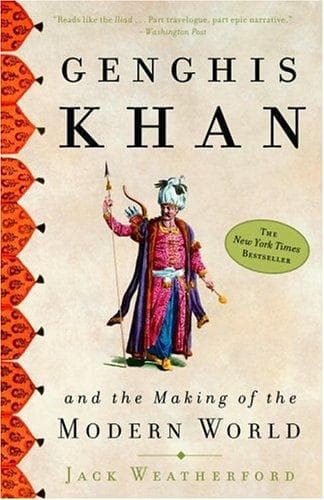
Genghis Khan and the Making of the Modern World
Jack WeatherfordPublished 2004 · ISBN 9780609809648
Our Review
I picked this up in a Beijing hotel bookstore aimed at expats. I’d just been deep in Renaissance history, and this book offered a chance to reflect on what made that flowering possible in the first place. Crisscrossing China for business, I kept being struck by the sheer scale of the infrastructure built to enable trade — and by how universal that human impulse seems to be. My curiosity runs deep here, but my education is decidedly Western. There’s an entire stretch of history unfolding during our Dark Ages that I knew almost nothing about, and I wanted in.
Weatherford’s revisionist history pushes back against the dominant Western narrative of the Mongols as history’s great destroyers. He argues that Genghis Khan’s empire was the premodern world’s most important engine of globalization — connecting East and West through trade, diplomacy, and the free movement of ideas, technologies, and peoples. The Mongols introduced meritocracy to governance, guaranteed religious freedom, and enabled the exchanges that eventually sparked the European Renaissance. The violence was real, and Weatherford doesn’t minimize it — but Mongol civilization has been systematically erased from Western memory, and this book is a bracingly effective corrective.
I came in believing Genghis Khan and his heirs were simply violent barbarians. I was astounded by how open-minded and hungry for knowledge they actually were, and by how the opening of that vast geography allowed ideas and technologies to cross-pollinate at an unprecedented scale. So much of it fascinated me — one of the first postal services, one of the earliest paper currency systems, the religious freedoms guaranteed by Khan’s conquering armies. The sheer reach of the empire, stretching from Shanghai to Russia to Iran, is staggering.
If your interests run across the history of warfare, trade, science, or technology, you’ll find something here. And for the broader story of how East-West connections shaped civilization, The Silk Roads by Peter Frankopan offers the grand narrative that Weatherford’s Mongol story fits into so powerfully.