Our Review
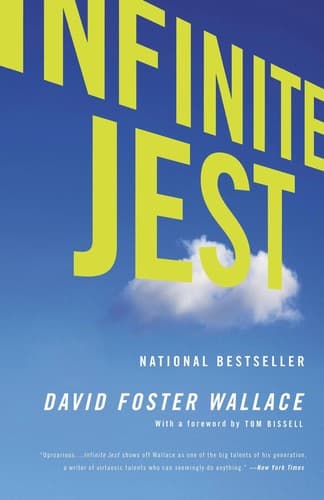
I was living in Brooklyn and traveling into the city every day in the late 90s when I first encountered this monster. At more than a thousand pages, it's a book you don't just read—it's an act of survival. Back then, cell phones were only just starting to become ubiquitous, but they were hardly what we'd call "smart"; you were lucky if you could play a game of Snake on them. While most people on the train just stared into the distance or dozed off over a newspaper, I was dragging this enormous brick everywhere I went, utterly unable to resist the fever dream David Foster Wallace was creating.
You simply can't turn away from this book. As soon as you read the first page, it grabs you with a scene that could be describing a character going mad or perhaps a heavy hallucinogenic trip. It isn't immediately clear which, and honestly, it doesn't matter; the prose is compelling enough to force a commitment to the staggering enormity of what lies ahead. Set in a near-future North America where entertainment has become so seductive it is literally lethal, the novel asks what we are willing to sacrifice for the next dopamine hit. Reading it now, in an era of algorithmic feeds and constant streaming, feels almost prophetic. Wallace wasn't being difficult for the sake of it; he was trying to capture something true about addiction, loneliness, and the human need for connection in a world designed to distract us from ourselves.
I think some people get frustrated by the constant footnotes and the stories that seem in error to the main plot, but for me, they were the best part. There are entire novels buried in those footnotes—dissertations, short stories, and adventures that expand the world. Under Wallace's pen, tennis becomes geometry and grammar becomes philosophy. It's an ambitious undertaking that borders on madness, but it's one that will break your heart and expand your mind simultaneously.
Discovering this book was like discovering how to read again for the first time. It was a whole new approach to the medium that put David Foster Wallace in a class of his own, and I often wonder if he spent the rest of his life trying to live up to the shadow of this masterpiece. It is a tremendous, life-altering commitment. I've had to read it twice now, and I found the experience just as enjoyable—and just as necessary—the second time through. In a culture of immediate gratification, it remains a stirring reminder of what happens when we finally stop and engage with something truly massive.
Readers preparing for the Infinite Jest experience might start with Brief Interviews with Hideous Men to acclimate to Wallace's style, while Consider the Lobster provides a more accessible showcase of his brilliant mind at work.