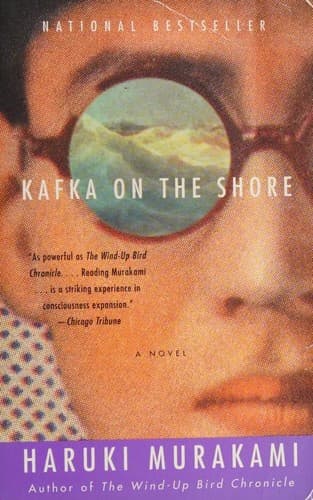
Our Review
Haruki Murakami's Kafka on the Shore begins as two separate stories—a fifteen-year-old boy who runs away from home in Tokyo, and an elderly man who lost his memory in a mysterious childhood incident and has since discovered he can talk to cats. By the end, these stories have converged in ways that feel simultaneously inevitable and impossible to explain. Along the way there is a magical private library in a small Japanese city, a cabin in the forested mountains where the boy retreats and nearly disappears into the woods entirely, fish raining from the sky, and a Colonel Sanders who may be the embodiment of something ancient and dangerous.
I came to this book through a roundabout way. My wife and I had just returned from Peru, where we had hiked four days up to Machu Picchu and then spent another week deep in the Amazon rainforest during a period of incredible flooding. Peru is a place that feels like a dream state, and I had taken The Wind-Up Bird Chronicle along for the trip. After I finished that one, I knew I had discovered something special and immediately dove into Kafka on the Shore.
There's a whole section of the book where one of the characters travels deep into the woods and stays in a cabin, and he has an experience where he gets lost in the woods in a timeless way. It's a dreamlike experience for both the character and the reader, and it's all very allegorical. I will forever remember the feeling of being lost in those woods with the character whenever I go off hiking.
Finding new authors that I connect with is always exciting, but there was something about Murakami that was different. His writing had an austerity to it while also being fantastical and full of symbolism. But there was a jazz-like quality to it as well. This is Murakami at full power—his dream logic fully operational, his compassion for lost and searching people fully engaged. I came away from this book feeling I had been somewhere I could not describe to anyone who had not also been there.
This book and Murakami in general is for anyone who enjoys magical realism, but wants something with a slightly shifted perspective, unlike most of the other magical realists. Murakami has an indescribable feeling that can only be experienced by reading him. For readers entering his world, The Wind-Up Bird Chronicle offers an even deeper descent into the surreal, with a narrative that weaves wartime history into contemporary mystery—and for what it's worth, it holds up beautifully in the Amazon rainforest.