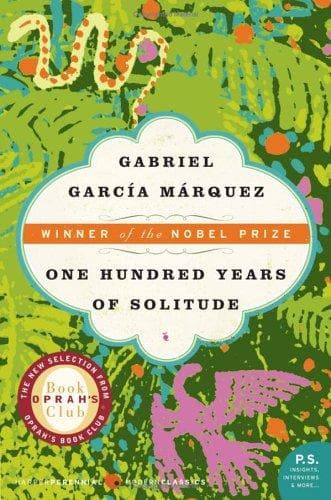
One Hundred Years of Solitude
Gabriel García MárquezPublished 1967 · ISBN 978-0060883287
Our Review
I remember quite clearly the first time I encountered the Buendía family. I was at a juncture in my life where my usual literary diet felt a bit malnourished; I was hungry for a narrative that offered more than just a linear sequence of events. A close friend had championed the works of Gabriel García Márquez to me years prior, but I think I lacked the internal stillness required to really listen back then. It was only during a quiet afternoon spent browsing a dusty corner of an old bookstore—long before I opened the doors to my own shop—that I stumbled upon One Hundred Years of Solitude. I didn’t immediately connect it to my friend’s recommendation, but the first page acted like a gravitational pull I couldn't resist.
The experience of reading this book for the first time was like discovering a new color. I had never encountered magical realism before, and the way Márquez weaves the impossible into the mundane caught me completely off guard. There is a breathtaking audacity in how he treats the arrival of a "flying carpet" or the ascension of Remedios the Beauty into the heavens with the same journalistic weight as he treats the local politics or the weather. The town of Macondo became a living, breathing character to me—a microcosm of our own world where the cyclical nature of time feels both tragic and comforting. I found myself particularly moved by the persistent ghosts of the past and the way the family’s solitude seemed to be an inherited trait, as tangible as their names.
One moment that truly stopped my breath was the description of the insomnia plague. The idea of people losing not just sleep, but the very memory of what things are and why they matter—having to label a cow with a sign that says "this is the cow, she must be milked every morning"—is such a profound metaphor for the loss of cultural identity. It resonates deeply with my own belief that we are, at our core, the stories we remember to tell. Márquez manages to balance this intellectual depth with a prose that is lush, rhythmic, and incredibly romantic in its scope.
Ultimately, this book served as a gateway for me. It demolished the silos I had built in my mind between "high art" and "popular storytelling." After finishing the final, shattering page, I felt an urgent need to explore the works of Isabel Allende, Haruki Murakami, and Jorge Luis Borges, realizing that reality is far wider than what we can see with our eyes alone. If you are looking for a story that is as vast as the human spirit and as intimate as a family secret, you must step into Macondo. It is a masterpiece of world literature that demands to be felt as much as it is read.