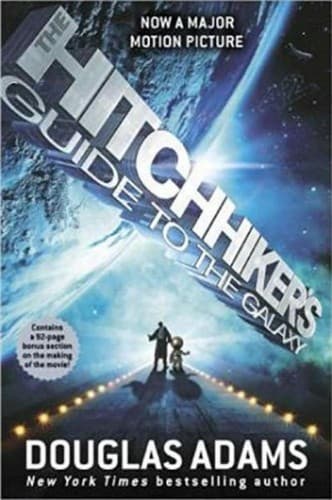
Hitchhiker's Guide to the Galaxy
Douglas AdamsPublished 1979 · ISBN 978-0345391803
Our Review
I was in college when I first discovered the brilliant insanity of Douglas Adams. We had so many wonderful bookstores in those days, and they would often entice customers by putting discount books in bargain bins right out on the sidewalk. I found the complete Hitchhiker's Guide to the Galaxy in hardcover at the very bottom of one of those piles. I took it to a nearby park and became so absorbed that I almost finished the first book that afternoon. It remains one of the funniest and most philosophically sneaky books in the English language.
The story begins with Arthur Dent, a perfectly ordinary Englishman whose house is about to be demolished to make way for a bypass — of course, that's just the prologue to the Earth itself being demolished for a hyperspace bypass. What follows is a sustained comic meditation on the improbability of everything and the complete indifference of the universe to human concerns. At the time, I was working my way through Kerouac and the heavy existentialists, and Adams fit into that rotation perfectly. After all, absurdism and existentialism are much closer neighbors than most people realize.
The writing was so smart and hilarious; it honestly felt like Star Wars meets Monty Python and the Holy Grail. I remember one specific passage about the Babel Fish that stopped me in my tracks and had people staring at me in the park while I laughed out loud: "'The argument goes something like this: 'I refuse to prove that I exist,' says God, 'for proof denies faith, and without faith, I am nothing.' 'But,' says Man, 'the Babel fish is a dead giveaway, isn't it? It could not have evolved by chance. It proves you exist, and, by your own arguments, you don't. QED.' 'Oh dear,' says God, 'I hadn't thought of that,' and vanishes in a puff of logic."
Before this book, my experiences with science fiction had always been dark and dystopian. While I certainly enjoyed that grit, I never knew the genre could be this much fun. Adams was doing deep philosophy while making you laugh so hard you forgot to notice. If you appreciate British humor, mind-bending comedy, and formal logic thrown in with a bit of slapstick, this book is essential. It is a reminder that while the answer to life, the universe, and everything might be forty-two, the journey to that realization is much better handled with a towel and a sense of humor.