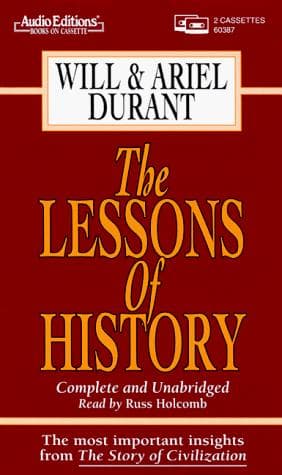
The Lessons of History
Will and Ariel DurantPublished 1968 · ISBN 9780945353874
Our Review
I found this book buried in my wife's section of the bookshelf, wedged between titles I hadn't touched in years. There is a specific season in a man's life when history becomes infinitely more compelling than the future, and apparently, I've arrived. I cracked The Lessons of History open just to sample a few pages and was immediately struck by the barefaced honesty of the prose — refreshing, a bit humorous, and pleasantly unsparing.
In just over a hundred pages, Will and Ariel Durant distill a lifetime of scholarship — specifically their eleven-volume Story of Civilization — into a succinct accounting of the patterns that have shaped our species. It is a remarkable meditation on the zoomed-out view of our collective folly and achievement. The Durants survey biology, morality, religion, and economics with a weary kind of wisdom, drawing lines from ancient Mesopotamia straight to the twentieth century with the confidence of scholars who have thoroughly earned their conclusions.
One passage stopped me in my tracks and stays with me every time I look at the news: they observe that history is an excellent teacher with few pupils, and that civilization is not inherited — it must be learned and earned by each generation anew. It rings so true today, especially when so many feel compelled to become talking heads about current events while remaining seemingly ignorant of the very chain of events that brought us to this moment.
Their conclusions are honest rather than comforting — power concentrates, inequality grows, war persists — yet they argue that civilization endures, nonetheless. There is something clarifying about that. It is a slim book that reads as both summation and testament, written when the authors were in their eighties and possessed of a clarity that only comes from looking backward for a very long time. Modern readers might pair this with Harari's Sapiens for a 21st-century synthesis, but where Harari seeks to provoke, the Durants simply instruct — with quiet, scholarly gravitas.
Whenever I meet a fellow armchair historian, this is the first book I recommend. Read it slowly, argue with it vigorously, and return to it often. It helped me understand the ground beneath my own feet by illuminating exactly how we arrived at this precise moment in history — which, it turns out, is precisely the point.