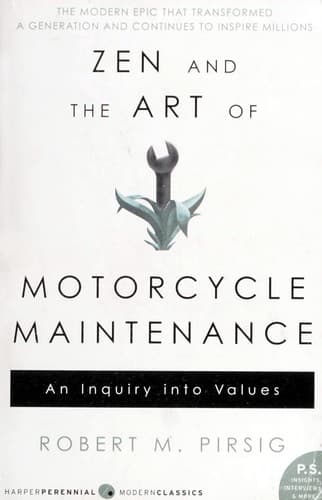
Zen and the Art of Motorcycle Maintenance
Robert PirsigPublished 1974 · ISBN 978-0060839871
Our Review
This book arrived at exactly the right moment. It was my freshman year of college, and Philosophy and Logic had given me a new lens for looking at the world — I was learning to question things I'd always simply accepted. I had always been an avid reader, but I leaned toward fiction over academic texts. Zen and the Art of Motorcycle Maintenance turned out to be a bridge between those two instincts — a philosophical novel, a road story, a meditation on how we think — and it shook me in ways I'm still working out.
Robert Pirsig's account of a cross-country motorcycle trip with his son is really a philosophical investigation into the nature of Quality — what makes something good, what separates craftsmanship from mere competence, and why the Western habit of separating romantic and rational ways of knowing has left us impoverished. I came to this book as someone who builds things — who tinkers with electronics and woodwork and radio antennas — and found in it an articulation of something I had always felt but never been able to name. There is a kind of meditation that happens when you are working carefully on something with your hands, when you are fully present inside a problem.
At the center of the book, a single question about the nature of Quality leaves the narrator — the philosopher Phaedrus — mentally paralyzed. He sits in silence for hours, the world moving on around him, the sun rising and setting, while he simply thinks. It is both the dramatic hinge of the narrative and its philosophical core. Pirsig seems to be arguing that this kind of deep, unhurried contemplation — sitting with a hard question until you've genuinely earned an answer — is itself a form of the Quality he's trying to define.
This is not an easy book, and it is not for readers looking for a road trip story. It is for those who enjoy dismantling their own assumptions — not because it leads anywhere useful, but because the thinking itself is worthwhile. It is one of the most important books I have ever read.
Pirsig returned to these themes seventeen years later in Lila: An Inquiry into Morals, which extends his Metaphysics of Quality into a full philosophical system — a more mature, if less personal, companion to this one.