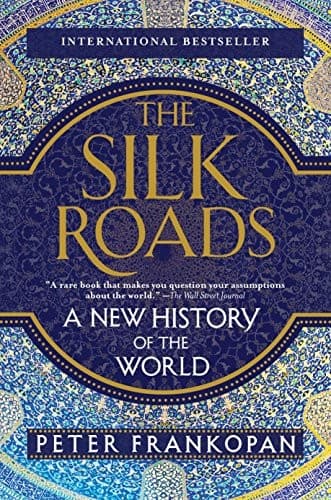
The Silk Roads: A New History of the World
Peter FrankopanISBN 9781101912379
Our Review
I picked this book up on my way to Xi'an. I was heading there for work, but also to stand in front of the terracotta warriors — because history always tastes better when you're breathing the dust where it actually happened. That instinct, the need to be physically present in the places where civilization pivoted, is part of why The Silk Roads hit me the way it did. Standing at what was once the most eastern point of the ancient world's great trading network, I felt Peter Frankopan's central argument settle in before I had even finished the first chapter.
His thesis, once you absorb it, is impossible to unsee: we have been telling history wrong. By centering civilization's story on Western Europe, we have missed the real axis of human development — the vast web of trade and cultural exchange stretching from the Mediterranean through Persia, Central Asia, and deep into China. Frankopan reclaims that middle ground and shows it was never peripheral at all. It was the engine. Empires rose and fell along these routes. Religions spread. Plague traveled. Ideas moved as fluidly as silk and spices, and the people who kept those networks alive were a class unto themselves — merchants and traders who consistently transcended political and religious divides in the name of commerce and connection. I have always found that remarkable about trade: at its best, it is an act of mutual recognition. You cannot trade with someone you refuse to understand.
The sweep of the narrative is genuinely staggering — from ancient Persia all the way to the War on Terror — and Frankopan carries it off with confident, engaging prose that never buckles under the weight. This is the kind of book I press into the hands of anyone involved in international business, because it reframes what they are doing. Moving goods across borders is not just logistics. It is participation in one of humanity's oldest and most civilizing impulses. My own travels through Asia for work brought me to ruins, temples, and dinner tables that changed how I understood everything I was reading. If you let it, trade can be a form of scholarship.
The most enduring thing The Silk Roads gave me is the conviction that learning about cultures other than our own remains the most reliable antidote to the ignorance that breeds conflict. That is not naïve — Frankopan documents plenty of violence and exploitation along these routes — but the thread of connection is always there, pulling even rivals back toward exchange.
If this reorientation of history grabs you the way it grabbed me, follow it with Jack Weatherford's Genghis Khan and the Making of the Modern World for the Mongol chapter of the story, or Roger Crowley's Conquerors to trace how maritime power eventually shifted the center of gravity elsewhere. But start here. It is a necessary correction — and one that lands differently when you read it standing at the edge of where the road once began.